
PAYAM RESEARCH GROUP

RESEARCH THEME 02

Architected Materials & Metamaterials

Computational design and investigation of architected materials, lattice structures and mechanical metamaterials with tailored properties.

← All research themes

About this research theme

This research theme explores the relationship between material architecture and effective mechanical response. Areas of interest include periodic and graded lattice systems, unit-cell design, geometrical optimisation, deformation mechanisms, structural instability, and the development of computational approaches for tailoring the behaviour of mechanical metamaterials.

Selected Research Projects

Explore representative research activities, project methods and directly associated research outputs.

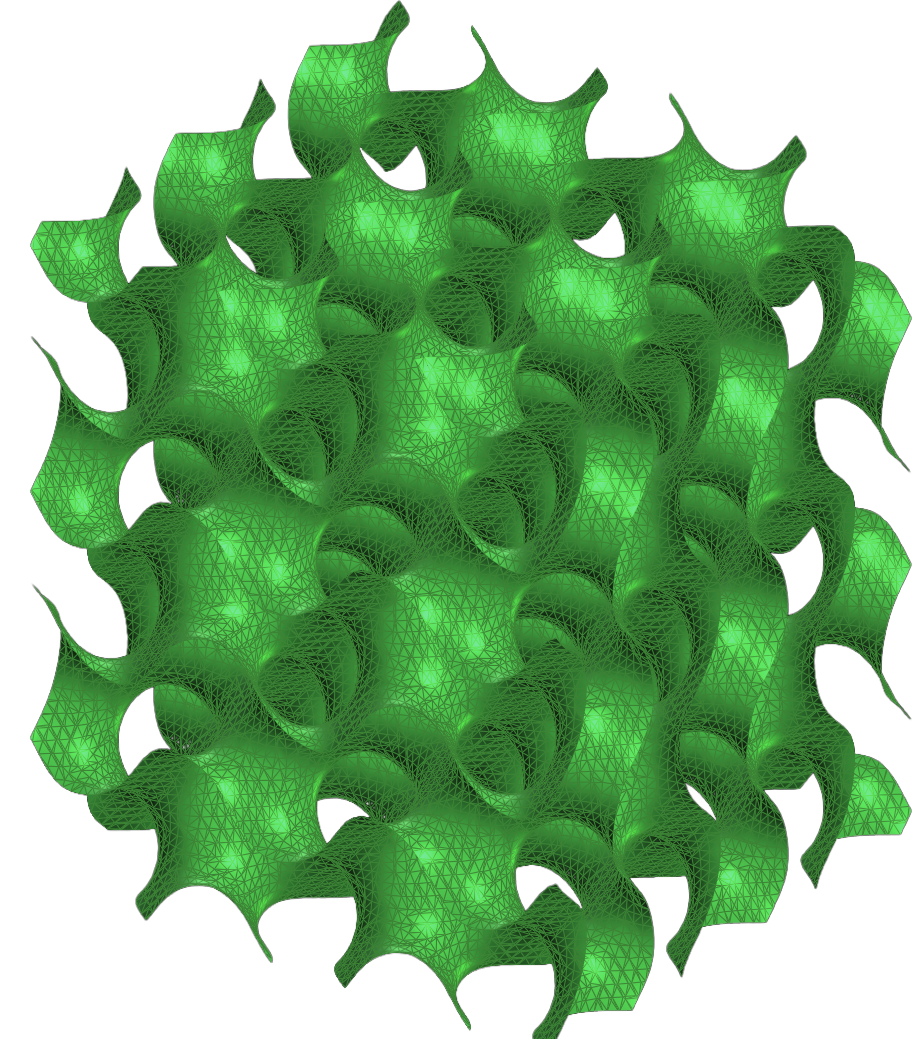
Meshed gyroid or architected lattice showing a conceptual mechanical-response field

Conceptual illustration of a meshed architected lattice.

PROJECT 01Research concept

Computational Design and Mechanical Evaluation of Architected Metamaterials

A geometry-driven research direction investigating periodic lattices, gyroid-like architectures and other architected unit cells. The proposed workflow combines parametric geometry, computational meshing and mechanical analysis to explore how architecture influences stiffness, deformation and load transfer.

Project focus and methodology
  • Parametric unit-cell and lattice generation
  • Finite-element meshing and boundary conditions
  • Relative density and stiffness–mass trade-offs
ONGOING RESEARCH

AI-Guided Design of Damage-Tolerant Mechanical Metamaterials

This ongoing research investigates whether bio-inspired branching and redundant load-transfer pathways can be embedded within monolithic mechanical metamaterials to preserve load-bearing performance following localised damage. The proposed approach combines parametric gyroid and spatially modified lattice design, finite-element analysis and machine-learning-guided optimisation.

Research objective: Investigate whether damage tolerance can be improved through spatially programmed lattice architecture and alternative load paths, without increasing overall material usage.
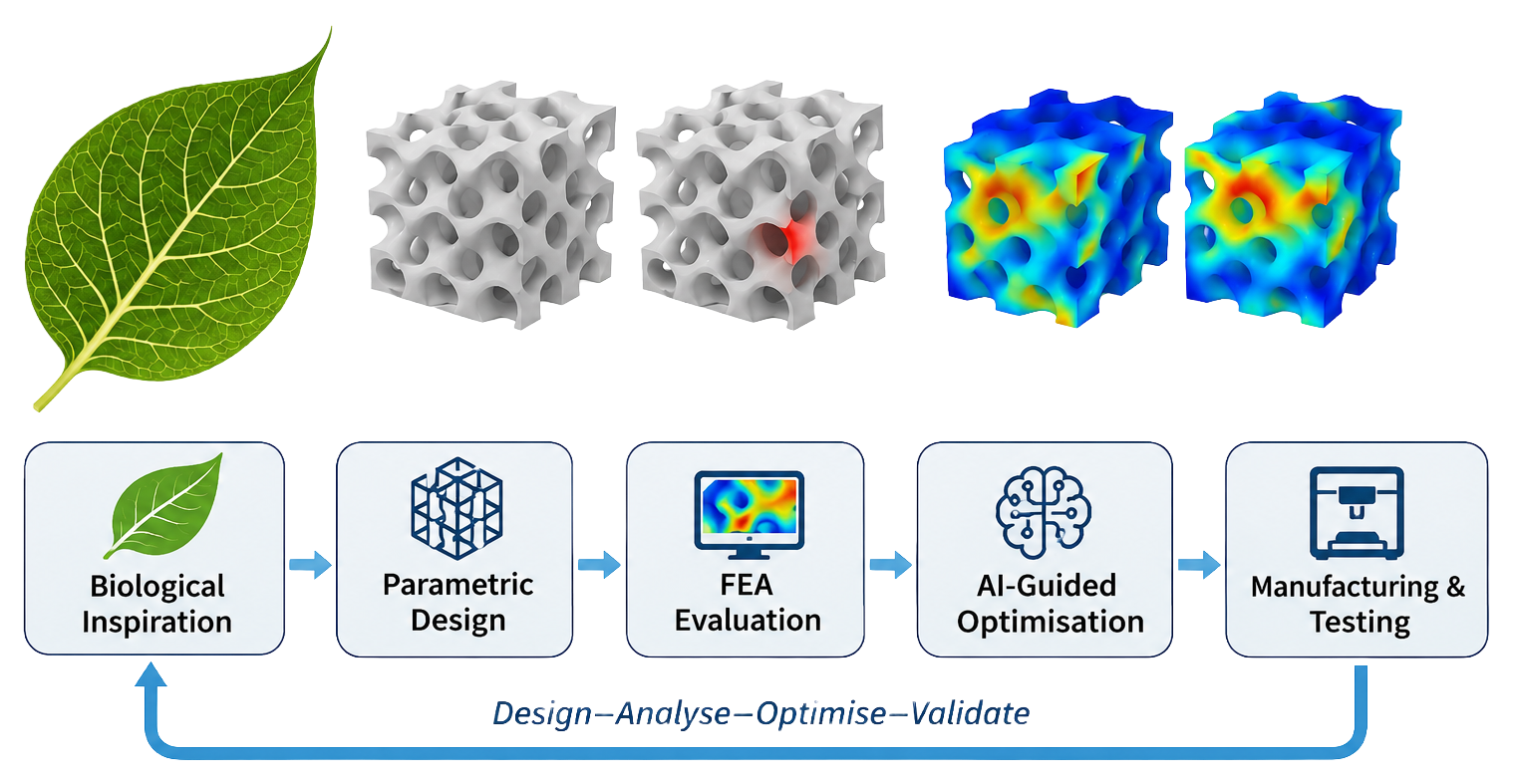
Conceptual illustration linking leaf-venation-inspired design, intact and locally damaged architected lattices, finite-element evaluation, AI-guided optimisation and experimental validation
Conceptual research illustration showing the proposed design, analysis, optimisation and validation workflow.
Proposed research workflow and methods
  • Generate reference sheet-gyroid and bio-inspired, spatially modified lattice architectures at approximately equal relative density.
  • Establish a reliable CAD-to-FEA pipeline to compare intact and locally damaged structures under equivalent loading and boundary conditions.
  • Quantify stiffness, stress redistribution and residual load-bearing capacity to assess potential damage tolerance.
  • Train and validate machine-learning models on verified finite-element results before using them for design optimisation.
  • Additively manufacture selected candidates and compare experimental mechanical measurements with model predictions.
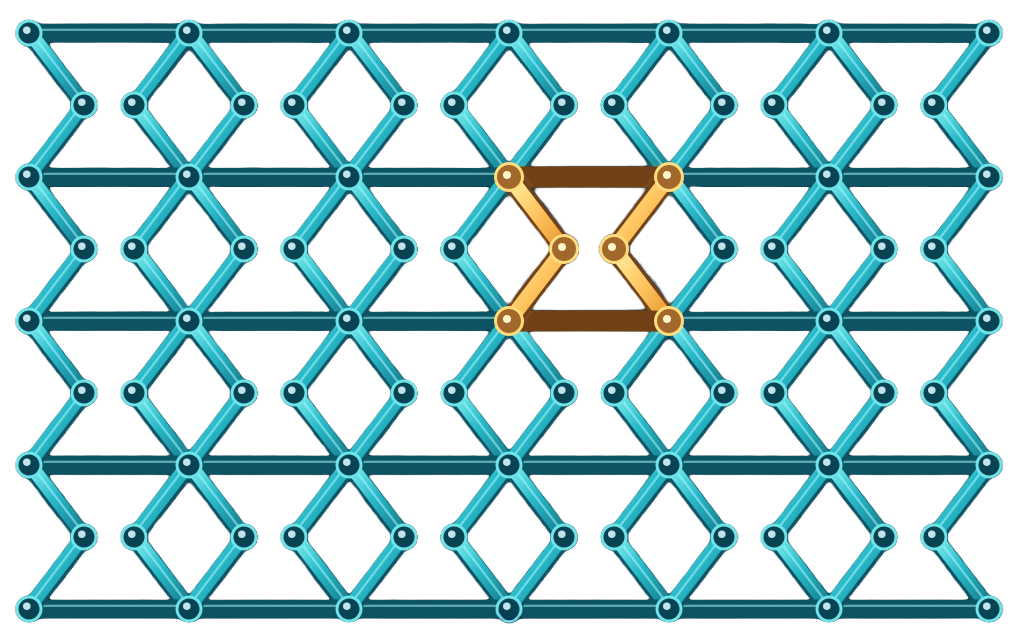
Mechanical metamaterial unit-cell array proposed for energy absorption or vibration control

Conceptual metamaterial design for energy absorption and vibration control.

PROJECT 02Suggested research direction

Metamaterial Unit Cells for Energy Absorption and Vibration Control

A proposed study comparing selected lattice and auxetic-inspired unit-cell architectures for their deformation mechanisms, energy absorption and dynamic response. It investigates geometry, strut and wall dimensions, and relative density through numerical simulations before considering prototype tests.

Project focus and methodology
  • Comparative unit-cell geometry design
  • Quasi-static energy-absorption evaluation
  • Potential vibration or dynamic-response assessment
  • Design optimisation and optional additive-manufacturing validation